
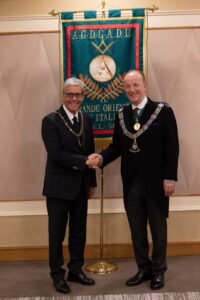
Venerabilissimo Gran Maestro,
Gli inglesi sono notoriamente poco portati per le lingue straniere ed io temo di non fare eccezione: leggo discretamente bene l’italiano ma non lo parlo molto bene, anche se parlo spagnolo, francese e un po’ di tedesco. Farò comunque del mio meglio per pronunciare queste poche parole in italiano, sperando che risultino comprensibili a tutti voi.
Anzitutto, e soprattutto, porto con me i saluti personali e i migliori auguri del Venerabilissimo Gran Maestro, Sua Altezza Reale il Duca di Kent, rivolti a voi Gran Maestro, e a tutti i Fratelli del Grande Oriente d’Italia.
Caro Antonio, sono davvero lieto del tuo invito a partecipare a questa nuova e speciale convocazione qui a Roma. L’Equinozio è un momento simbolico dell’anno, certamente più nella vostra Tradizione che per la nostra, ma posso ben immaginare che questo incontro possa rappresentare una tappa importante per il Grande Oriente e per il suo futuro, e sono profondamente grato di poterne essere parte.
Siamo rimasti separati per molto tempo.
Sono infatti il primo Pro Gran Maestro a visitare il Grande Oriente d’Italia e spero sinceramente che la fratellanza massonica possa continuare ad avvicinarci come Massoni e consentirci di lavorare in quella pace e armonia che i Fratelli italiani meritano.
È stato per me un grande piacere accogliere a Londra il tuo predecessore, il Venerabilissimo Fratello Bisi, quando ci fece visita nel 2023, oltre trent’anni dopo l’ultima visita di uno dei suoi predecessori. Ora ho finalmente anch’io l’opportunità di vedere di persona, e per la prima volta, come i Fratelli del Grande Oriente lavorano e vivono la Massoneria qui in Italia. Ciò che ho visto mi ha profondamente colpito e commosso e credo di poter parlare a nome di tutti i vostri ospiti delle delegazioni straniere nel ringraziare te e i Fratelli del Grande Oriente d’Italia per la straordinaria accoglienza e per il programma così generoso e ospitale che ci avete offerto in questa Città Eterna, in questa capitale di tutte le capitali.
Caro Gran Maestro, Fratelli tutti, sono ancora più commosso nel ricevere dai Fratelli, e dalle tue mani Antonio, questa importante decorazione, la più alta onorificenza massonica prevista dal vostro ordinamento. L’Ordine di Giordano Bruno, Classe Oro, ha per me un significato davvero speciale. Loporto oggi davanti a voi con orgoglio e lo accolgo non soltanto come simbolo dell’armonia e della buona volontà ristabilita tra le nostre Gran Logge. Ha per me anche un profondo valore personale e sono sinceramente grato, ed onorato, per il modo in cui avete voluto rendermi omaggio oggi.
Quando i Fratelli del Grande Oriente d’Italia istituirono quest’Ordine, credo abbiano scelto saggiamente il suo nome, ed ora io stesso traggo beneficio da quella scelta e dalla loro saggezza.
Forse non sapete che Giordano Bruno ha trascorso diversi anni nella mia Nazione. Questo fatto purtroppo oggi in Inghilterra non è più molto noto; probabilmente la colpa è più nostra che sua. So naturalmente che qui, a Campo de’ Fiori, nel luogo in cui fu crudelmente messo a morte, sorge la sua celebre statua: raffigurata nel medaglione che il Gran Maestro mi ha consegnato. Non vorrei però soffermarmi sui conflitti che questa storia richiama ,né su ciò che crea divisione tra gli uomini. Preferisco sottolineare ciò che abbiamo in comune.
Per quanto mi riguarda, condivido con Bruno almeno due cose: Anzitutto, anch’io ho studiato teologia. In secondo luogo, Bruno arrivò a Oxford nel 1583; ed io anche ho frequentato quella stessa meravigliosa Università, anche se circa quattrocento anni dopo Bruno; ed è proprio lì che ho incontrato la Massoneria. Purtroppo sappiamo che Bruno non trovò ad Oxford un’accoglienza particolarmente calorosa. Sono sollevato che la mia permanenza in quella stessa Università abbia prodotto meno controversie filosofiche e teologiche e confido che le mie parole di oggi ricevano da voi un’accoglienza più benevola di quella riservata allora alle sue lezioni. Mi è stato detto che Bruno fu tra i primi a concepire l’infinità dell’universo, popolato da innumerevoli mondi. Eppure, nel suo pensiero, questa molteplicità non conduceva ne’ risultava in una frammentazione. Giordano Bruno ricercava un’unità più profonda, che non richiedesse uniformità. Questo ideale dell’ unità che non si riduce al conformismo è un’idea che parlacon particolare forza all’esperienza massonica di ogni tempo. Quando ci riuniamo in Loggia proveniamo da ambienti e nazioni differenti, parliamo lingue diverse, professiamo fedi diverse e talvolta abbiamo anche opinioni politiche differenti. Siamo liberi di mantenere le nostre convinzioni, eppure impariamo a lavorare insieme in armonia.
Bruno visse molto prima che la Massoneria speculativa assumesse la sua forma moderna, e non mi permetterei certo di trasformarlo retroattivamente in un Massone. Vi sono tuttavia aspetti del suo pensiero che anticipano chiaramente l’Illuminismo e la riscoperta delle virtù e degli ideali classici. Questo è forse l’elemento più importante che abbiamo in comune e vorrei soffermarmi su di esso.
Fratelli, i nostri princìpi affondano le loro radici nell’umanesimo del Rinascimento, di cui Bruno, il Nolano, l’uomo del Sud, rappresenta un esempio straordinario. Ma quel nuovo pensiero trova forse un’espressione altrettanto significativa in Erasmo, uomo del Nord. Tra l’altro, ho la fortuna di lavorare a Cambridge nello stesso College nel quale Erasmo, che so essere molto caro al Grande Oriente d’Italia, visse e lavorò per cinque anni.
Da quel nuovo pensiero, e dopo il trauma delle guerre di religione in Europa e delle guerre civili in Inghilterra, Scozia e Irlanda, la Massoneria giunse a fiorire tra la fine del Seicento e l’inizio del Settecento, ispirata dagli stessi ideali di ragione illuminata. Tra quelli che ancora oggi custodiamo vi sono certamente: la tolleranza, la moderazione, la meritocrazia, il governo costituzionale, la libertà e la ricerca della conoscenza di sé. Le nostre due Gran Logge ci invitano a perseguirli non soltanto in Loggia, ma anche nella nostra vita quotidiana, come individui.
Come tutti sapete, Fratelli, noi inglesi non nasciamo filosofi e non siamo particolarmente noti come metafisici. I miei compatrioti fanno fatica con il pensiero di Bruno ancora oggi. In Inghilterra siamo notoriamente concreti e pragmatici, e dobbiamo fare i conti con questa nostra caratteristica.
Permettetemi dunque, per il loro bene e per il mio, di provare un approccio più semplice. Come potrei esprimere nel modo più chiaro il principio unificante sul quale, per noi inglesi, si fonda la Massoneria?
Direi così: un Massone è colui che fa ciò che è giusto anche quando le circostanze sono difficili e quando farlo non è né comodo né conveniente.
Credo che, se chiedessimo conferma di questo a James Anderson, autore delle nostre Costituzioni del 1723, difficilmente troveremmo qualcosa su cui avrebbe da obiettare. Anche se, naturalmente, Anderson era scozzese, e forse avete un’idea di ciò che gli scozzesi pensano di noi inglesi…
Vedete, a Londra, e forse persino a Edimburgo, questa sarebbe stata un’ottima battuta, ed il mio discorso sarebbe potuto anche finire qui.
Devo ancora imparare da voi a pensare in maniera italiana. A noi inglesi piace ridere di noi stessi. Forse, se almeno su questo siamo d’accordo, possiamo riuscire a sorridere tutti insieme, fraternamente.
Ma tornando alle cose serie, vi è un altro punto sul quale non mi trovo affatto in disaccordo con Anderson. Nelle nostre Costituzioni massoniche egli attribuì all’Italia un posto di particolare rilievo, come custode e artefice della rinascita dell’architettura classica.
Riconosco quindi volentieri il profondo debito di gratitudine che tutta la Massoneria ha nei confronti del vostro Paese e che fu formulato per la prima volta proprio dal nostro James Anderson. Nell’edizione riveduta delle Costituzioni, pubblicata nel 1738, egli presentava l’Italia come la terra nella quale le arti- compresa la nostra Arte Reale – erano state preservate, recuperate e nuovamente portate alla perfezione.
Forse dobbiamo leggere tutto questo più come mitologia massonica che come storia in senso letterale, ma cito volentieri le sue parole di elogio:
«Così l’Italia tornò ad essere la Signora del Mondo, non per la Potenza Imperiale, ma per le Arti del Disegno».
Di nuovo: «Così l’Italia tornò ad essere la Signora del Mondo, non per la Potenza Imperiale, ma per le Arti del Disegno».
È una frase straordinaria. La grandezza dell’Italia risiede nella creazione e nell’arte creativa. Non nell’esercizio del potere, ma nella capacità di dare forma bella e armoniosa alle idee umane. Confesso che queste parole mi hanno ispirato nel considerare anche i momenti più difficili della nostra storia comune.
Il rapporto tra bellezza e verità appartiene naturalmente a una lunga tradizione platonica che condividiamo. In questo senso, la bellezza massonica della colonna corinzia non è semplice decorazione: dà armonia alla nostra forza e orientamento alla nostra saggezza. E così come Bruno ci invita a ricercare l’unità nella diversità, Platone continua a ricordarci che la bellezza può elevare la mente verso la verità. Anderson, a mio avviso, ha portato entrambe queste idee nel lavoro pratico e morale della Loggia, e spero che potremo continuare a costruire su queste fondamenta anche in futuro.
Venendo a Roma ed essendo il primo Pro Gran Maestro a farlo come vostro ospite, so bene di non essere certo il primo Massone inglese a visitare questa terra. Penso a Firenze, dove una prima riunione di Loggia con fratelli inglesi è documentata già nel 1731, sotto il sole italiano, e dove, come in tante altre città italiane, tanti Fratelli inglesi giunsero durante il loro Grand Tour, portando con sé ideali spesso plasmati anche da una prospettiva massonica.
Questi fratelli inglesi venivano in Italia alla ricerca dell’antichità, dell’architettura, dell’arte, della filosofia e del sapere. È noto come, anche attraverso la Massoneria, instaurassero rapporti con studiosi, artisti e uomini di cultura italiani. Vedete Fratelli, il Grand Tour non aveva il solo scopo di accrescere le conoscenze, ma anche di formare il carattere. Ci si aspettava che il viaggiatore tornasse non soltanto più informato ed educato, ma anche un uomo migliore. La Massoneria richiede uno sforzo simile a ciascuno di noi.
Percorriamo la Loggia così come percorriamo il mondo: non semplicemente per vedere di più, ma per imparare a vedere diversamente.
È anche in questo spirito che sono venuto a farvi visita: per imparare a guardare la nostra storia recente attraverso i vostri occhi, ma anche per aiutarvi a guardare quegli anni più difficili attraverso i miei.
Per trent’anni le relazioni formali tra le nostre due Gran Logge sono state interrotte. Riconosciamo quel capitolo della nostra storia senza riaprire vecchie controversie, ma anche senza fingere che non sia esistito. Possiamo avere il coraggio di guardarlo oggi da una prospettiva diversa, all’interno della storia più ampia che condividiamo.
Quando nel 2023, a seguito della richiesta del Gran Maestro Bisi, il riconoscimento fu ristabilito, quella decisione non creò ex novo una relazione dove prima non ve ne erano state. Recuperò ed oggi valorizza relazioni le cui fondamenta erano state poste molto tempo prima, talvolta anni, talvolta generazioni addietro.
I legami tra Massoni inglesi e italiani attraversano tre secoli, attraversano la Storia delle nostre obbedienze, ed abbracciano diverse tradizioni. Non abbiamo bisogno né di riscrivere né di nascondere il passato. Le tessere nere fanno parte del pavimento a scacchi, di quel disegno a mosaico della storia che dobbiamo imparare a vedere nelle giuste proporzioni e al quale siamo chiamati ad aggiungere il nostro contributo, riconoscendo il disegno più grande del quale ciascuna parte è elemento costitutivo.
Non limitiamoci dunque a ereditare narrazioni in conflitto tra loro. Proviamo invece a scriverne insieme una armoniosa.
Oggi non vi saluto all’inizio di un nuovo rapporto, ma per rinnovarne uno che ci è caro.
Che la franchezza ne ponga le fondamenta, che l’affetto fraterno ne sia il cemento, e che il nostro scopo sia abbellirlo con tutto ciò che la Massoneria saprà realizzare.
Venerabilissimo Gran Maestro, Fratelli, vi ringrazio
per questo grande onore,
per il calore della vostra accoglienza e
per avermi dato l’opportunità di rivolgermi a voi
oggi.
Il testo in inglese
Most Worshipful Grand Master,
The English are notoriously bad at speaking other languages and I am afraid I can only read and not speak Italian, although I do speak Spanish, French, and some German. I will do my best to deliver these few words in Italian and I hope they will make sense to you all.
Firstly, and most importantly, I bring with me the personal greetings and best wishes of the Most Worshipful The Grand Master, His Royal Highness the Duke of Kent, for you as well as for all the Brethren of the Grand Orient of Italy.
Dear Antonio, I was delighted to be invited by you to attend this new and special convocation you are holding here in Rome. This is a symbolic time of the year – for you more so than for us – but I can well imagine that this gathering may come to mark a significant stepping stone for the Grand Orient and its future, and I am so thankful to be a part of that.
We have stood apart for a long time, I am indeed the first Pro GM to visit the Grand Orient and it is my great hope that masonic fellowship will continue to bring masons together, and allow us to work in that peace and harmony which the Brethren of Italy deserve.
It was a great pleasure for me to host your predecessor, Most Worshipful Brother Bisi, in London when he came there in 2023, over thirty years since one of his predecessors was able do so; now I finally have the opportunity myself to see at first-hand, and for the first time, how the Brethren of the Grand Orient of Italy work and enjoy their Freemasonry here. I have been moved and most impressed by what I have seen, and may I speak in the name of all your guests, and for all the foreign delegations, when I thank you, and the Brethren for the great welcome and the wonderfully generous and hospitable program in this Eternal City, in this Capital City of all Capital Cities.
Most Worshipful Grand Master, Brethren, dear Antonio, I am even more deeply moved to receive from the Brethren and from your hands this most significant decoration – the highest masonic honour of your constitution. The Order of Giordano Bruno, Gold Class is very special indeed, and I am wearing it with pride in front of you all and accept it not just as a symbol of the re-established harmony and good will between our Grand Lodges; it means a great deal to me personally and I am grateful and humbled for the way you have honoured me today.
When your predecessors instituted this order, I think they chose its name wisely, and may I now benefit from their wisdom. Did you know that Giordano Bruno has spent several years in my country? Sadly, this is not so well known to us in England anymore, which may be our fault more than his; I know, of course, that he has a famous statue here on the Campo de’ Fiori where he cruelly died, the same statue represented on the medallion the Grand Master has presented to me. However, let it not be our characteristic to dwell on the implicit conflicts, or any of the things that divide men but let us stress what we all have in common.
I for one share with him the following: Firstly, I was a student of theology as was he; secondly, Bruno came to Oxford in 1583, and I went to that same university just about 400 years later, and it is there that I have encountered Freemasonry. He was sadly not made to feel welcome, and I am relieved, that my own time there generated fewer philosophical and theological controversies, and trust that my remarks today will receive a warmer reception than his lectures did there.
I am told Bruno was among the first to envisage the infinity of the universe – containing innumerable worlds, and yet this multiplicity did not, for him, lead to fragmentation. He sought a deeper unity not requiring uniformity, and this speaks powerfully to the Masonic experience of all times. When we come to Lodge meetings from different backgrounds, nations, with different languages, different creeds and at times varying political outlooks, we are allowed to hold different opinions but we nevertheless learn to work in harmony in the Lodge.
Bruno lived well before speculative Freemasonry assumed its modern form, and far be it from me to make him retrospectively into a Freemason. However, there are aspects of his philosophy which possess a clear resonance of the Enlightenment to come, and of the rebirth of classical virtues and ideals. This is the most important thing we have in common, and let me dwell on that for the rest of my speech.
Brethren, our principles are based on the humanism of the Renaissance as it is well exemplified by Bruno, the Nolan, the Southerner; but the new thinking is perhaps equally well exemplified for instance by Erasmus, a Northerner, and you will forgive my mentioning him but I happen to work in the same College in which he lived and worked for 5 years, and I know Erasmus to be very dear to the Brethren of the Grand Orient of Italy.
Sparked by the new thinking, and following the trauma of the Wars of Religion in Europe and the Civil Wars in England, Scotland, and Ireland, Freemasonry came to flourish in the late 17th and early 18th Centuries, inspired by the same ideas of enlightened reason; among the most remarkable that we still treasure today are surely tolerance, moderation, meritocracy, constitutional government, liberty, and the pursuit of self-knowledge, and both our Grand Lodges encourage us to follow these not only in the Lodge but in our daily lives as individuals.
As you will all know, Brethren, we English are not born philosophers, or known metaphysicians, and my compatriots struggle with Bruno‘s thoughts to this day. We are famously plain and pragmatic in England, and that is something we have to work with.
So let me try a plainer approach for their sakes and mine: How can I best articulate the unifying principle on which Freemasonry rests for us in England?
I suggest that a Freemason is someone who does the right thing even in difficult circumstances and when it is neither convenient nor expedient to do so.
I feel if you check this with James Anderson, who wrote our Constitutions in 1723, there is little you can find that he would disagree with in that, although he was a Scotsman, and you may have an idea what they think of us English…
You see in London, or even in Edinburgh, this is a fine joke. And my speech would be over now.
I have yet to learn from you how to think in an Italian way. We English like to laugh at ourselves. Perhaps, if you agree with that, we can smile together fraternally.
But seriously, there is one other thing also in which I do not disagree with Anderson. He gave Italy a prominent place in our Masonic Constitutions as guardian and reviver of classical architecture.
I therefore happily acknowledge a deeply felt debt of gratitude that all Freemasonry owes to your country and which was first formulated by our very own James Anderson. In his revised edition published in 1738 he presented Italy as the land in which the arts – including our Royal Masonic Art – had been preserved, recovered and brought once again to perfection; and while we may have to read this as Masonic mythology, rather than literal history, I happily quote his praise:
“Thus Italy was again the Mistress of the World, not for Imperial Power, but for the Arts of Designing.”
Again:
“Thus Italy was again the Mistress of the World, not for Imperial Power, but for the Arts of Designing.”
It is a remarkable phrase. Italy’s greatness rests upon creation and creative art, not upon power but upon her ability to give beautiful and harmonious form to human ideas. I confess that these words have inspired me when looking even at the most difficult moments of our shared history.
The relationship between beauty and truth belongs, of course, to a longstanding Platonic tradition which we all share. In that sense, the Masonic beauty of the Corinthian column is not decoration; it gives harmony to our strength and purpose to our wisdom. And as Bruno has invited us to seek unity within diversity, Plato continues to remind us that beauty can raise the mind towards truth. Anderson for me has brought both ideas into the practical and moral work of the Lodge, and I hope to be able to rely on his foundation for the future.
Coming to Rome and being the first ever Pro GM to do so as your guest, I know profoundly that I am not the first English Freemason on these shores. I look to Florence where a first Lodge meeting can be dated in 1731 under the Italian sun, and where Brethren flocked on their Grand Tours bringing with them ideals often shaped by Masonic perspectives.
They came to Italy in search of antiquity, architecture, art, philosophy and learning. It is well known that through Freemasonry, they formed relationships with Italian scholars, artists and men of learning. Their Grand Tour was intended not only to increase knowledge, but to form their character, and travellers were expected to return not merely better informed, but improved. Freemasonry asks something similar of each of us.
We perambulate the Lodge as we travel the world, not merely to see more, but to learn to see differently.
In that sense, I have also come to visit you, to learn to look at our recent history through your eyes but also to help you look at those darker years through mine.
For thirty years, formal relations between our two Grand Lodges were interrupted. We acknowledge that chapter without reopening old controversies, but equally without pretending it did not exist. May we boldly succeed to view it differently under the unifying perspective of our shared history.
When recognition was restored in 2023, upon Grand Master Bisi’s request to us, that decision did not create relationships where none had existed; it recovered and holds dear all those relationships whose foundations had been laid over time, at times years, at other times generations ago.
Links between English and Italian Freemasons extend across three centuries, across the History of our communions, and encompass different traditions, and we do not need to rewrite or hide the past; the dark squares are a part of the pavement, of a chequered floor, a mosaic of history which it is for us to see in proportion and to add to, recognizing the grander design of which it forms a part.
Let us therefore not simply inherit conflicting stories but attempt to write a harmonious one together.
I greet you today not at the beginning of a new relationship, but to renew the one that is dear.
May candour establish the groundwork, brotherly affection cement it and may beautifying it with all Masonic achievement become our purpose.
Most Worshipful Grand Master, Brethren, I thank you for this great honour, for the warmth of your welcome and for the opportunity to address you today.